The Quiet Many

How membership organizations stop hearing the people they were built for, and what to do about it.

Scroll ↓

A field guide

I was paying dues to be represented, and watching the representation go somewhere else.

Early in my flying career I paid into the same union as the senior pilots at our parent airline. Dues scaled with pay, so they paid several times what I did, and when the room decided, it was never my voice in it. The money sat with them, and you could feel where its center of gravity was.

That pull is structural, not personal. When one organization represents members of very unequal size, and its resources scale with that size, its attention drifts toward the biggest members without anyone choosing it. The people it was built for end up outside it. Those are the quiet many.
The drift

It happens one reasonable decision at a time

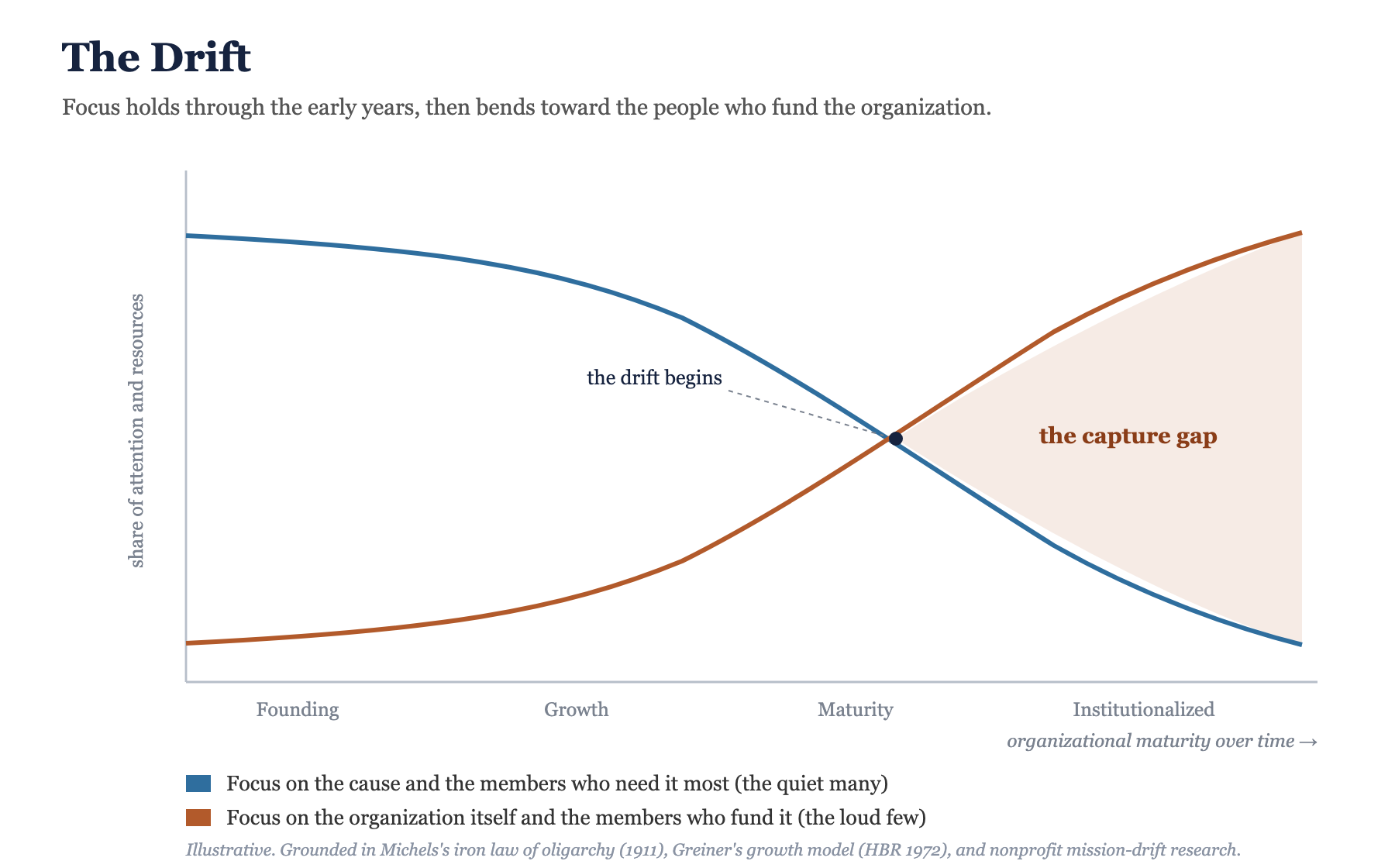
No villain is required. The organization listens hardest to the members who fund it most, and the value slowly bends toward them. A trade association, a professional society, a union, a mission nonprofit: they differ in who pays, and they share this one failure.

A chart of an organization drifting from the whole membership toward its biggest, best-funded members over time, opening a capture gap.
The drift: value bends toward the few who fund it, away from the many who need it.

The early warning

You hear it before you see it

The drift never shows up in the financials. It shows up in the questions members start to ask. One of these from one member is noise. The same one, over and over, from members with a real claim and little power, is signal.

“What am I actually getting for my dues?”
“Is this organization still for someone like me?”
“Why should I renew?”

Your usual instruments miss it. Revenue counts the payers who stayed, never the members who slipped away. Engagement counts the members already showing up, the loud, and misses the ones drifting out of range.


The diagnostic

Read one real decision in three layers

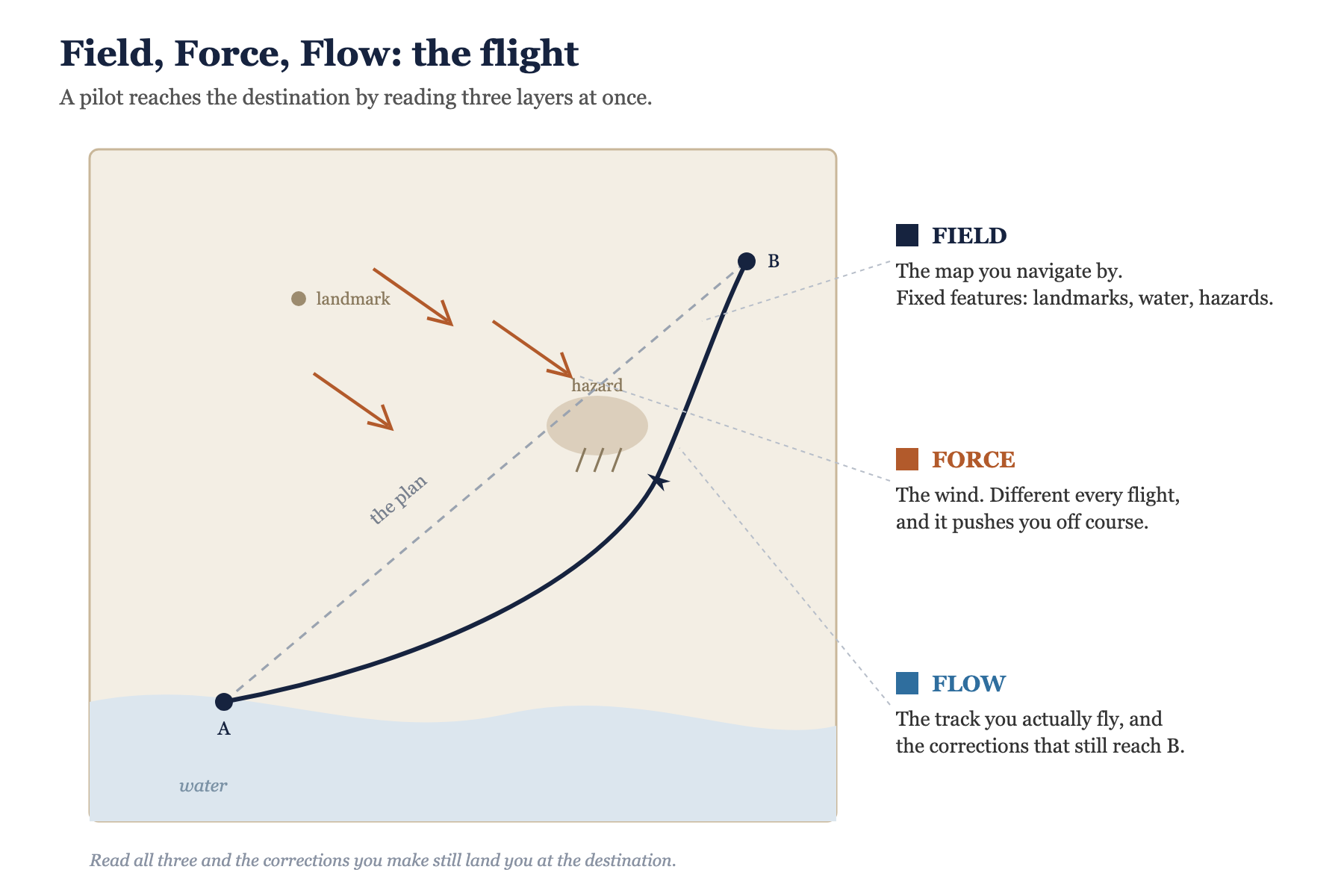
You cannot see this from the org chart. A pilot does not navigate by the org chart of the airspace either. You read the map you fly over, the wind that pushes you off course, and the track you actually fly.

A flight diagram: the map with fixed features, the wind pushing the plane off course, and the actual track flown to the destination.
The flight: the map, the wind, and the track you actually fly.

An organization has the same three layers. Read them on one decision with money or hours attached.

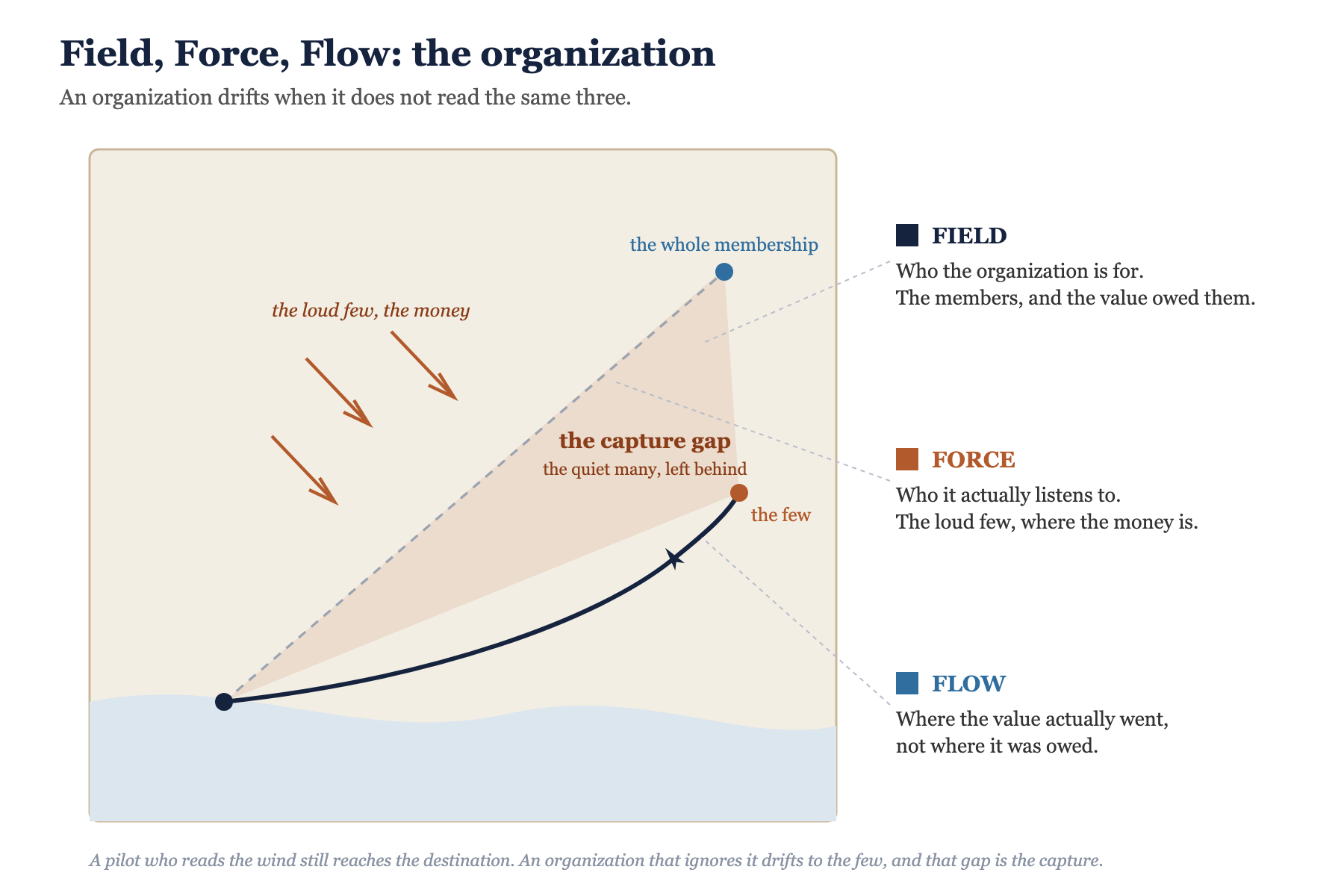
Field, Force, Flow for an organization: the whole membership at top, the loud few and the money pulling the track down toward the few, and the capture gap in between where the quiet many are left behind.
The gap between who it is for and who it served is the diagnosis.
Field  ·  who it is for

The one thing members would lose if you vanished that no employer, vendor, or free substitute could replace. If you cannot finish that sentence, that is your first finding.

Force  ·  who it listens to

On a live decision, who really moves it. Not the chart, the wind. Mark who is affected and has no line to the center. Those are the quiet many.

Flow  ·  who it served

Where the money, the staff hours, and the leader's own calendar truly ran. The budget and the calendar cannot be spun. When the value the Field owes to the whole runs, in the Flow, to the few the Force favors, you have found the gap.

One commitment

The floor

Serve only the neediest and you starve. Serve only the funders and you are captured. The floor is the line: a minimum of value owed to the whole membership, no matter who pays.

Run it on your own organization

The three-layer read

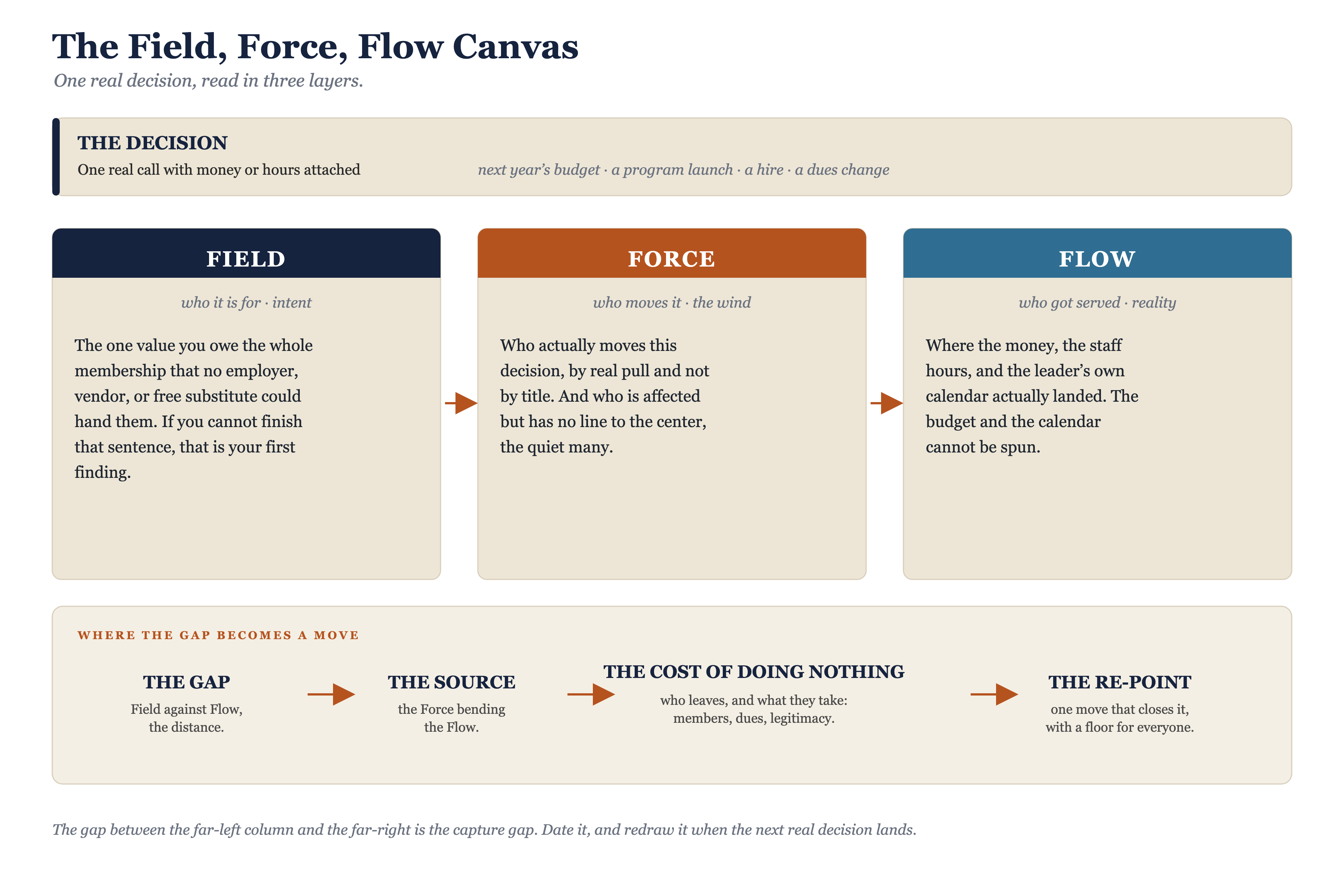
Pick one real decision with money or hours attached: next year's budget, a program launch, a hire, a dues change. Answer in a line each.

The Field, Force, Flow canvas: a one-page worksheet with the decision across the top, Field, Force, and Flow as three columns, and the gap, source, cost of doing nothing, and re-point across the bottom.
The one-page canvas. The live version below fills in the same read.

The example is filled in. Replace it with your own.

What does this decision owe the whole membership?

Example — replace with your own

Who actually moved this decision?

Example — replace with your own

Where did the money and the hours actually go?

Example — replace with your own


What to do

Finding the gap is the easy part

Closing it is not. Expect the fight, keep the floor so no one can call it a raid, and let the map, not your opinion, do the arguing. Make the room to re-point by cutting the work that serves no one's real need. That is usually what funds the work that serves the quiet many.


Academics diagnose. Consultants prescribe. I move people across.

I am an operator who has moved institutions through exactly this change, more than once, including in places that fought it the whole way. If you recognize your own organization in this, start with one real decision and the three layers above.

Take the guide with you

You just read the whole field guide. Keep the polished PDF for your board, and get the weekly Brief while you are at it.

The Aviation Intelligence Brief: one note a week on building organizations worth belonging to. No spam, unsubscribe anytime.

The Quiet Many, a field guide from ETL Advisory.